Kanlanth sauna systems include infrared sauna configurations designed for residential wellness spaces, featuring hemlock wood construction, far infrared heating technology, and home installation options. The Kanlanth infrared sauna lineup includes two-person home infrared sauna models, indoor wellness cabins, and hemlock infrared sauna designs. Available features may include carbon heating panels, digital controls, tempered glass doors, integrated lighting, and space-efficient layouts. This independent product guide provides Kanlanth sauna specifications, features, dimensions, and product information to help visitors better understand the current Kanlanth sauna range before comparing available purchasing options.
The 2-person Red Cedar model measures 0–1 MG EMF — a stated engineering spec, not a marketing label, on carbon crystal panels designed to operate well below international safety thresholds.
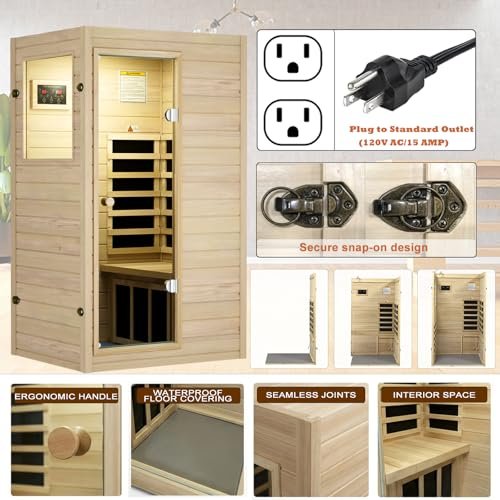
Every Kanlanth model runs on 120V/15A — no electrician, no dedicated circuit, no permit — except the 4-person outdoor sauna, which requires a 20A plug.
Canadian Hemlock and Red Cedar panels interlock with tongue-and-groove joinery — no adhesives, no special tools — and most 1- to 2-person models go together in about 30 minutes with one other person.
From the 29.3 × 36.6 inch mini aspen unit for studio apartments to the 52.76 × 68.1 inch 4-person outdoor sauna, there's a Kanlanth model that fits your actual floor plan — including a collapsible steam tent that stores behind a couch.
The Kanlanth lineup splits into two distinct categories: 13 far-infrared wood saunas built from real lumber with low-EMF carbon crystal heaters, and one portable steam tent that uses wet heat and collapses for storage. Products are sorted below from smallest to largest — entry 1-person models first, scaling through 2-person indoor units, upper-tier cedar builds, outdoor saunas, the 4-person flagship, and the steam tent last, since it's a genuinely different product that deserves its own consideration.
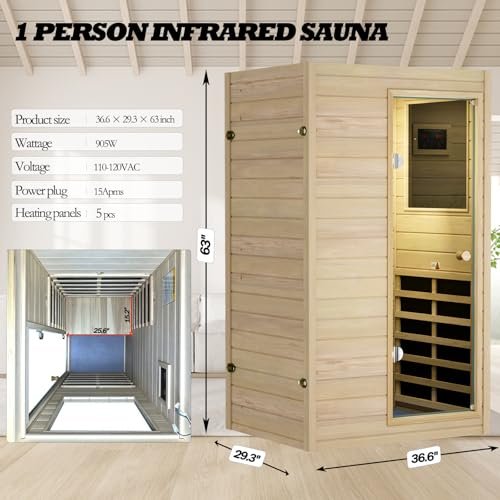
The smallest wood sauna in the lineup — 36.6 × 29.3 × 63 inches exterior — built from resin-free European Aspen that stays odorless and cool to the touch on the outside. Five far-infrared epoxy panels at 905W make it the most energy-efficient model Kanlanth makes, reaching 140°F on a standard 15A outlet. Left-door configuration.
Best for apartment and small-space buyers who want the lowest footprint and most efficient power draw — European Aspen's hypoallergenic, odorless properties make it the right call for anyone sensitive to wood scents.
See on Amazon
Identical specs to the left-door version — same 36.6 × 29.3 inch footprint, same 905W European Aspen build, same 140°F max and 15A outlet requirement — with the door swing reversed. Interior measures 33.46 × 26.38 × 59.06 inches with a 220-lb weight limit, Bluetooth, and 3-year limited warranty included.
Same unit as the left-door model — choose based on which wall your outlet is closest to and which direction gives you the most comfortable entry for your specific room layout.
See on Amazon
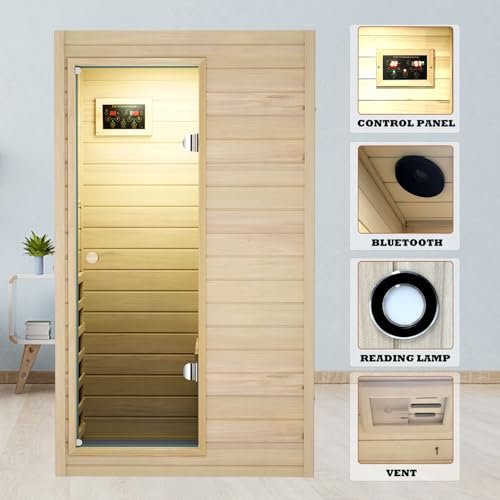
Spruce wood construction gives this entry-level unit a warmer, more rustic grain than the aspen models — same exterior dimensions (36.6 × 29.3 × 63 inches), slightly higher wattage at 950W, and it adds an LED reading light not found on the aspen versions. Five far-infrared epoxy panels, button control panel, Bluetooth, standard 15A outlet.
The LED reading light and rustic spruce grain make this the better pick if you plan to use sessions as downtime with a book — functionally near-identical to the aspen models but with a warmer visual character.
See on Amazon
The panoramic glass-wall design is the real story here — tempered side-glass panels create a 270-degree view that eliminates the closed-in feeling most 1-person saunas produce. Canadian Hemlock construction, 5 carbon fiber panels at 1,300W (meaningfully more power than the entry models), and a 10-foot power cord. Exterior: 38.3 × 33 × 73 inches.
If you're hesitant about infrared saunas because you're mildly claustrophobic, this is the model that resolves that — the glass-wall design makes the interior feel dramatically more open than a standard wood-wall cabin.
See on Amazon
Two-person version of the panoramic glass-wall design — Canadian Hemlock, 5 carbon heating panels at 1,500W, dual Bluetooth speakers, and 2 LED reading lights in a 43.2 × 38.3 × 73 inch exterior. The open-concept glass architecture carries over from the 1-person glass-wall model, now with enough interior width for shared sessions. Standard 120V/15A.
The best option for couples who want a shared sauna without giving up the open, light-filled feel of the glass-wall design — the 43.2 × 38.3 inch footprint fits a large master bathroom or home gym corner.
See on Amazon
Seven low-EMF carbon crystal heating plates deliver 360-degree surround heat — more heater coverage than any other 1-person model in the lineup. Canadian Hemlock, 1,200W, 33.86 × 33.86 × 73 inch exterior with a near-square footprint, 600-lb seat load, mortise-and-tenon assembly, and a 6mm tempered glass door. Interior: 30.8 × 30 × 69 inches. Power cord runs 118 inches.
The most complete 1-person wood sauna Kanlanth makes — 7 heaters versus 5 in the entry models means heat reaches your sides and front, not just your back, which is the difference buyers with muscle soreness notice most.
See on Amazon
Traditional wood-forward 2-person design without the panoramic glass — Canadian Hemlock, 5 carbon crystal panels at 1,500W, interior measuring 39.96 × 32.48 × 69.17 inches with a 660-lb seat load. Tongue-and-groove assembly typically takes about 30 minutes with two people. Dual Bluetooth speakers, 2 LED reading lights, LCD control. Exterior footprint: 43 × 35 × 73 inches.
A slightly smaller footprint than the glass-wall 2-person model (43 × 35 versus 43.2 × 38.3 inches) and a more enclosed, traditional cabin feel — the right choice if you prefer wood walls over glass and want a tighter exterior profile.
See on Amazon
Nine low-EMF carbon crystal heating panels at 1,750W — the most heaters of any indoor model in the lineup — with a max temperature of 149°F versus the 140°F ceiling on lower-powered models. Dual control panels (one inside, one outside), 10–15 minute preheat, chromotherapy lighting, and a cited service life of approximately 14 years. Exterior: 44 × 39 × 77 inches.
The step up to 149°F max and 9 heaters is real — if you've used a lower-powered infrared sauna and felt it didn't get warm enough, this is the model that addresses that complaint directly.
See on Amazon
Red Cedar construction with a dedicated heating panel on the door itself — 7 wall panels plus 1 door panel — targeting the knee and calf areas that standard wall-only layouts leave cold. EMF stated at 0–1 MG, the most specific measurement in the lineup. Dual LCD control panels inside and out, 3 chromotherapy lights, 2 outdoor lamps, 149°F max. Exterior: 47.2 × 39.4 × 75.6 inches.
The door heater panel is a genuine functional difference, not a cosmetic one — buyers who use saunas for lower-body recovery consistently notice the difference in knee and calf warmth compared to wall-only heating configurations.
See on Amazon
Outdoor-rated Red Cedar sauna with 6 far-infrared heating plates plus a near-infrared red light — the NIR addition targets skin health separately from the far-infrared heat therapy, making this the only outdoor model with that dual-light combination. Rated for outdoor temperatures from -10°F to 149°F, 1,750W on a standard 15A outlet. Exterior: 58.19 × 40.79 × 81.18 inches.
Built to stay outside year-round — the -10°F cold-weather operating rating and weatherproof Red Cedar construction mean it functions through a Colorado or Minnesota winter without being brought indoors or covered beyond normal maintenance.
See on Amazon
Mahogany (described in product materials as peach wood) outdoor 2-person unit — denser and darker than cedar, with a fine grain and waterproof exterior construction. Six far-infrared epoxy panels at 1,750W, plus a near-infrared beauty light and dual chromotherapy LEDs. Dual LCD display, Bluetooth, 149°F max, 3-meter power cord. Same exterior dimensions as the cedar outdoor model: 58.19 × 40.79 × 81.18 inches.
Virtually identical specs to the Red Cedar outdoor model but with mahogany's denser, darker aesthetic — choose this one if you prefer a warmer-toned wood character over cedar's lighter, more aromatic finish.
See on Amazon
The largest and most powerful unit Kanlanth makes — 8 carbon crystal panels at 2,050W in a mahogany cabin measuring 68.1 × 52.76 × 82.7 inches exterior with an interior of 58.8 × 55.9 × 70.1 inches. Pitched roof, weatherproof cover, 660-lb seat load per seat, 149°F max with a 20–30 minute preheat. This is the only model in the lineup that requires a 20A outlet rather than 15A.
The 20A outlet requirement is the critical planning detail — confirm your installation location has a 20A circuit before ordering, because every other Kanlanth model runs on 15A and this one does not.
See on Amazon
Red Cedar with the door heater panel design — 7 wall panels plus 1 door panel at 1,450W — in a compact 34.9 × 34.9 × 72.4 inch exterior that works as either a solo or tight 2-person unit. Interior: 31.5 × 31.5 × 68.11 inches. Dual control panels inside and out, 7-color chromotherapy, 149°F max, 10–15 minute warm-up. Seat load: 660 lbs.
This sits between the entry hemlock 1-person units and the full 2-person cedar tier — if you want Red Cedar with the door heater panel but don't need the full 2-person interior width, this is the more space-efficient way to get it.
See on Amazon
Wet steam, not far-infrared — a fabric and stainless steel tent with a 3.0L steam generator at 1,000W that reaches 150°F in about 8 minutes. Exterior: 31.5 × 31.5 × 77 inches, folds for storage, includes a folding chair rated to 330 lbs, wireless remote, and waterproof floor mat. Automatic power-off and leakage protection built in. Weighs 22.8 lbs total.
This is a fundamentally different product from the wood sauna lineup — wet steam heat, no permanent footprint, stores behind a sofa — best for renters, frequent movers, or anyone who wants to try heat therapy before committing to a wood cabin.
See on AmazonDiscover the full product lineup with current selection on Amazon.
Browse all products on AmazonThe four smallest Kanlanth saunas share the same exterior footprint and the same 120V/15A outlet requirement — but they differ in wood type, wattage, and a few features that actually matter depending on how you plan to use yours. This table covers the decision-relevant specs for each.
| Feature | Mini 1-Person Aspen (Left Door) | Mini 1-Person Aspen (Right Door) | Mini 1-Person Spruce | 1-Person Hemlock Glass Wall |
|---|---|---|---|---|
| Wood type | European Aspen | European Aspen | Spruce | Canadian Hemlock |
| Exterior dimensions | 36.6 × 29.3 × 63 in | 36.6 × 29.3 × 63 in | 36.6 × 29.3 × 63 in | 38.3 × 33 × 73 in |
| Interior dimensions | 33.46 × 26.38 × 59.06 in | 33.46 × 26.38 × 59.06 in | 33.46 × 26.38 × 59.06 in | Not specified |
| Wattage | 905W | 905W | 950W | 1,300W |
| Heater panels | 5 far-infrared epoxy panels | 5 far-infrared epoxy panels | 5 far-infrared epoxy panels | 5 carbon fiber panels |
| Max temperature | 140°F | 140°F | 140°F | 140°F |
| LED reading light | No | No | Yes | Yes |
| Glass wall design | No | No | No | 270-degree side glass |
| Warranty | 3-year limited | 3-year limited | Not specified | Not specified |
| Weight limit | 220 lbs | 220 lbs | Not specified | Not specified |
The aspen models are the right call for anyone prioritizing the smallest footprint, lowest power draw, and a 3-year warranty — choose left or right door based purely on your room layout. The spruce model adds an LED reading light in the same footprint for buyers who want to use sessions as reading time. The Hemlock Glass Wall steps up to 1,300W carbon fiber panels and the open panoramic design — a meaningful upgrade if you want more heat output or if the enclosed feel of a standard wood cabin gives you pause.
The single most common reason buyers return a home sauna is a footprint surprise — it looked manageable in the listing photos and then didn't clear a doorway or left no room to walk around. Here's how each category of Kanlanth sauna maps to real living situations, using actual exterior dimensions.
The three mini models — both aspen variants and the spruce — share a 36.6 × 29.3 inch floor footprint. To put that in context, that's roughly the size of a standard corner shower. It fits against a bedroom wall without claiming the whole room, and it clears a standard 32-inch interior doorway when disassembled for moving.
One thing to account for: the door swings outward. You need about 30 inches of clearance in front of the unit when the door is open, so plan for that before deciding which wall to put it against. That's why Kanlanth sells the aspen model in left-door and right-door configurations — the choice matters more than it looks like it will.
The 1-person hemlock models step up in footprint. The glass-wall version (B0B244J4NW) measures 38.3 × 33 inches — not dramatically larger, but it needs that extra depth for the side glass panels. The 7-panel hemlock unit (B0CQ4BLY1F) is actually the most compact of the mid-range 1-person models at 33.86 × 33.86 inches, a near-square footprint that fits neatly in a home gym corner without projecting into the room.
The 1-2 person Cedar Door Heater (B09LH6QPLZ) sits at 34.9 × 34.9 inches — almost identical — and gives you the Red Cedar construction and door heater panel in a footprint that works in a dedicated sauna corner without needing a full spare room.
The 2-person models need meaningfully more floor space. The hemlock classic (B0CR4FSN52) measures 43 × 35 inches — call it about 3.6 × 2.9 feet. The hemlock 9-panel model (B0CW52P5J7) goes to 44 × 39 inches. And the 2-person cedar models reach 47.2 × 39.4 inches for the indoor door-heater version (B0FYXJ9PVZ). None of these are particularly large in absolute terms, but basements with low clearance need to account for the height too — most of these run 73 to 77 inches tall (just over 6 feet), so a basement with a 7-foot ceiling gives you about 10 inches of clearance above the unit, which is fine for ventilation.
Ceiling vents are built into every model — they need a few inches of airspace above to work properly. Don't push the unit flush against a drop ceiling.
The two outdoor 2-person units — Red Cedar (B0GSQL7KZV) and Mahogany (B0CLZKFY38) — both measure 58.19 × 40.79 × 81.18 inches exterior. That's nearly 5 feet long and 3.5 feet wide, plus door clearance. A standard 10 × 12 foot covered patio handles this comfortably. Both are rated for outdoor temperatures down to -10°F, so covered-but-not-enclosed works in most US climates.
The 4-person mahogany outdoor sauna (B0CHF9QR9G) is a different scale entirely — 68.1 × 52.76 × 82.7 inches exterior, with an interior of 58.8 × 55.9 × 70.1 inches. That's a structure that needs a dedicated outdoor space, ideally a patio, deck area, or backyard pad. It can also go indoors — the listing notes indoor or outdoor use — but you'd need a room roughly 8 × 7 feet with ceiling clearance to spare. Confirm your 20A outlet situation before anything else with this model.
The portable steam tent (B0FKSZXL1S) is the only product in the lineup that makes sense here. At 31.5 × 31.5 × 77 inches assembled and 22.8 lbs total, it sets up in under 10 minutes, disassembles completely, and stores in a bag. It's wet steam rather than far-infrared, which is a different experience — but for someone who moves every year or shares a lease, a wood sauna cabin isn't realistic, and the tent is.
One honest caveat: the steam tent's 330-lb chair capacity is lower than the 600–660 lb seat ratings on the wood models. And the tent's fabric walls retain heat differently than insulated hemlock panels — expect to use it in a room with a closed door for best results.
The Kanlanth lineup doesn't have a single best model — it has models that are right for specific situations. Here's how the four main buyer types map to specific products, based on how people actually use these saunas.
If you're using a sauna primarily for post-workout muscle soreness and sleep, preheat speed and heater coverage matter most. The 7-panel hemlock unit (B0CQ4BLY1F) is the best 1-person option here — seven low-EMF carbon crystal panels mean the heat reaches your sides and shoulders, not just your back. That's the difference between sitting in a warm room and actually feeling the heat work on fatigued muscle groups.
For athletes who want to do sessions with a partner or need a dedicated recovery corner in a home gym, the 2-person 9-panel hemlock model (B0CW52P5J7) reaches 149°F — the highest indoor max in the lineup — with a 10-15 minute preheat. Getting a post-training session in while you're still cooling down doesn't require a long wait.
One realistic expectation: infrared saunas at 140–149°F will produce significant sweating and elevated heart rate, but this is not equivalent to a 185°F traditional Finnish sauna session. The physiological response is similar — the experience feels different. Athletes who've used high-heat traditional saunas and loved them should be honest with themselves about that before buying.
For someone who wants a 30-minute evening ritual that actually switches the mind off, the entertainment features matter as much as the heat specs. The 2-person cedar door-heater model (B0FYXJ9PVZ) includes 3 chromotherapy lights, dual Bluetooth speakers, 2 outdoor lamps, and dual inside/outside control panels — meaning you can set the temperature before you even walk in and adjust lighting mid-session without touching the control panel. That adds up to a session that feels intentional rather than utilitarian.
The 1-2 person cedar door-heater (B09LH6QPLZ) delivers the same feature set in a 34.9 × 34.9 inch footprint, which fits a corner of a master bedroom. Buyers in this category who've tried meditation apps and found them too effortful tend to find the combination of heat, music, and colored light easier to sustain as a daily habit than anything requiring active mental participation.
Chromotherapy is ambient lighting, not a medical treatment. Don't buy based on therapeutic color claims — buy it because a session with warm amber light and quiet music is objectively more relaxing than a session in a plain wood box.
Start here: do you want to try heat therapy before committing to a wood sauna, or are you ready to commit but working with a small space?
If you want to try first, the portable steam tent (B0FKSZXL1S) is the honest answer. It sets up in under 10 minutes, stores behind a sofa, and costs far less than any wood sauna. The experience is wet steam rather than far-infrared dry heat — a real difference — but it answers the "will I actually use this" question before you make the bigger investment.
If you're ready for a wood sauna and working with a small apartment, the mini aspen models (B0GSVWTDH1 or B0GSVSJXP5) are the right fit — 36.6 × 29.3 inch footprint, 905W on a standard 15A outlet, and the aspen wood's odorless, hypoallergenic properties work well in a small bedroom where the scent of cedar would be overpowering. Choose left or right door based on your wall outlet location and the direction you'll enter from.
For families or couples who want a shared sauna that holds up over years of regular use, the decision comes down to how many people will use it simultaneously and where it will live.
Indoor household use: the 2-person cedar door-heater model (B0FYXJ9PVZ) is the strongest all-around option — Red Cedar construction, 0–1 MG EMF (the most specific measurement in the lineup), 149°F max, 660-lb seat load, and the door heater panel that eliminates the cold-leg problem on longer sessions. It's the most complete indoor 2-person unit Kanlanth makes.
Backyard or covered patio installation for the whole family: the 4-person mahogany outdoor sauna (B0CHF9QR9G) is the flagship. Eight carbon crystal panels at 2,050W, 660-lb seat load per seat, weatherproof mahogany, pitched roof. The 20A outlet requirement is the only real planning hurdle — confirm your outdoor electrical situation before ordering, because retrofitting a 20A circuit is a licensed electrician job in most states.
Far-infrared saunas and traditional Finnish-style saunas produce a similar physiological response through completely different mechanisms. Understanding the difference helps you set accurate expectations — and explains why comparing temperatures between the two types is mostly misleading.
Traditional saunas heat the air to 170–195°F, and your body warms up because it's surrounded by very hot air. Far-infrared saunas work differently: the carbon crystal panels emit infrared radiation in wavelengths (roughly 5–15 micrometers) that the body absorbs directly as heat, penetrating a few centimeters into tissue without first heating the air to the same extreme. The result is that your core temperature rises, your heart rate climbs, and you sweat — at an ambient air temperature of 140–149°F rather than 185°F+.
This is why the temperature comparison often confuses buyers. You're not comparing equivalent experiences when you say "but a Finnish sauna gets to 190°F." The mechanism is different. Most people who use both describe infrared heat as feeling gentler on the lungs, easier to tolerate for longer sessions, and less physically demanding in the way that extreme dry heat can be demanding for people with certain cardiovascular sensitivities.
Regular sauna use — both traditional and infrared — is associated with elevated heart rate, increased sweating, and temporary muscle relaxation. Studies on traditional sauna use, particularly from Finnish research institutions, show associations with reduced cardiovascular risk over years of consistent use (3–4 sessions per week). The research base for infrared specifically is smaller and less robust than the traditional sauna literature, though it does exist.
The honest position: infrared saunas produce real physiological effects. The evidence for specific therapeutic outcomes — blood pressure reduction, improved sleep, joint pain relief — is promising but not definitive in the same way that decades of Finnish population research is. Anyone shopping primarily based on medical claims should look at the actual published literature rather than marketing copy, including ours.
The r/Sauna community's skepticism of infrared is worth taking seriously. If you've used traditional Finnish saunas and what you want is that specific experience — the intense dry heat, the löyly steam, the ritual of cold plunge and rest — an infrared sauna is not going to replicate it. They're genuinely different experiences. The infrared version is quieter, easier to maintain, and fits in a spare bedroom. The traditional version is hotter, louder, and culturally richer in the way that Finnish sauna culture specifically is.
Most buyers choosing Kanlanth aren't replacing a traditional sauna ritual. They're adding heat therapy to their week in a form they can actually access on a Tuesday night after work. Those are different goals, and infrared is well-suited to the second one.
Some Kanlanth models top out at 140°F; the upper-tier models reach 149°F. The 140°F ceiling occasionally gets flagged in reviews as "not hot enough." In practice, 30 minutes at 140°F in a well-insulated hemlock cabin produces significant sweating for most people — but if you want the highest available temperature in the lineup, the 9-panel hemlock (B0CW52P5J7), the cedar door-heater models, and both outdoor units all reach 149°F. That's the max available in far-infrared at this power range and something to check before buying if temperature is a priority for you.
Buyers who get consistent results from a home sauna in the first month are almost always the ones who set accurate expectations before the first session. Here's what the Kanlanth lineup actually delivers — and what takes time to figure out.
Preheat time is one of the most practically important specs in the lineup, and it varies meaningfully across models:
The practical difference: if you want to start a session immediately after getting home, a 10-minute preheat on the 1,750W models means you're in by the time you've changed clothes. A 20-minute preheat on the entry models requires planning ahead — set the timer from your phone or just build the wait into your routine.
Nine degrees sounds like a minor difference. It isn't. In a well-insulated wood cabin, 149°F feels meaningfully more intense than 140°F — sweat starts faster, breathing feels warmer, and most people find 20-minute sessions at 149°F more demanding than 30-minute sessions at 140°F. Neither is objectively better; they serve different goals.
If you're using the sauna for slow, meditative decompression and can sit comfortably for 30–45 minutes, 140°F is often more sustainable daily. If you want a more intense session in less time — closer to what you'd get from traditional sauna culture — the 149°F models give you more of that.
The "200 rule" is a traditional sauna guideline — the combined temperature in Fahrenheit and humidity percentage should sum to around 200 for an ideal session (for example, 170°F temperature with 30% humidity). This applies specifically to traditional Finnish saunas and isn't directly applicable to far-infrared, which operates on a different mechanism at lower ambient temperatures.
What does apply to infrared: the buyers who report the most consistent results — better sleep, less muscle stiffness, lower perceived stress — are almost uniformly the ones using their sauna 3 to 4 times per week, not once. A single session produces effects that last a few hours. Regular sessions seem to compound over weeks. The first 30 days are about establishing the habit, not evaluating a single session.
Most buyers report that the first one or two sessions feel like a novelty — interesting, warm, slightly unfamiliar. By week two, the routine starts to settle: most people figure out their preferred temperature, session length, and whether they want music or silence. The sleep effects, when they appear, tend to show up around week three or four of consistent use — not because the sauna suddenly works better, but because the cumulative effect of repeated heat exposure and post-session cooldown starts to build into a pattern the body anticipates.
One honest caution: if your plan is to use the sauna aggressively for weight loss as a primary mechanism, adjust that expectation. You'll sweat and lose water weight temporarily. The caloric expenditure from a 30-minute infrared session is real but not dramatic. Think of it as one component of an active lifestyle, not a standalone intervention.
Every Kanlanth sauna — wood cabin and steam tent alike — includes built-in safety cutoffs, but there are specific groups of buyers who should consult a physician before first use. This section covers both the technical safety specs and the personal health considerations worth knowing.
All wood sauna models include an automatic overheat cutoff at 110°C (230°F) — well above any operating temperature the units reach in normal use. The sensor is independent of the user-controlled temperature setting, so even if the LCD control malfunctions, the thermal cutoff operates as a separate protective layer. The steam tent (B0FKSZXL1S) includes both automatic power-off and leakage protection on the steam generator — two separate failsafes on the water-heating component.
Ceiling vents are present on all wood cabin models. They're not optional — keep them unobstructed during sessions for proper air circulation. Running a sauna in an unventilated, sealed room is not recommended regardless of model.
All Kanlanth wood saunas use carbon crystal far-infrared panels described as low-EMF. The most specific published measurement in the lineup is on the 2-person Red Cedar door-heater model (B0FYXJ9PVZ), which states an EMF level of 0–1 MG. That figure sits well below international safety thresholds set by ICNIRP (International Commission on Non-Ionizing Radiation Protection), which guidelines establish exposure limits orders of magnitude above what typical consumer electronics — including saunas — emit during normal use.
What low-EMF means in practice: the carbon crystal panels are engineered to minimize electromagnetic field emission as a design spec, not as a marketing claim added after the fact. For most buyers, this is relevant context rather than a pressing safety concern. For the subset of buyers who have researched EMF specifically and were hesitant about infrared saunas for that reason, carbon crystal panels at 0–1 MG address that objection directly.
Infrared sauna use involves elevated core temperature and increased heart rate — the same physiological response that exercise produces. That's beneficial for most healthy adults and worth discussing with a physician for the following groups:
None of this is unique to Kanlanth — these are standard infrared sauna safety considerations that apply across the category. If you're a healthy adult without the above conditions, standard heat safety practices apply: hydrate before and after sessions, start with shorter sessions at lower temperatures, and don't use the sauna immediately before sleep if you run hot.
The Kanlanth portable steam tent (B0FKSZXL1S) uses a 1,000W steam generator with a 3.0L water reservoir — an open-water heating system rather than a sealed electrical element like the wood sauna panels. The leakage protection cuts power if the generator detects moisture in places it shouldn't be. Keep the power cord and generator unit away from standing water, and don't overfill the reservoir beyond the marked max level. The fabric enclosure itself is waterproof and heat-rated, but it's not airtight — the tent design inherently allows some steam to escape, which is by design for safety.
Warranty terms vary across the Kanlanth lineup, and a few specific post-delivery scenarios are worth knowing about before you order — particularly given that these are oversized LTL shipments, not standard parcel deliveries.
The warranty documentation across the lineup is not uniform, which is worth noting plainly:
If warranty length is a deciding factor for your purchase, the 3-year coverage on the aspen models is the clearest documented commitment in the lineup. For other models, contact the Kanlanth Amazon storefront directly to confirm current warranty terms before ordering.
Every wood sauna in the lineup ships as an LTL oversized freight item — not a standard parcel. This means:
The recommended protocol across Kanlanth listings is consistent: inspect packaging on delivery, photograph any damage before moving panels inside, and contact Kanlanth through the Amazon buyer-seller messaging system within 24 hours. Multiple listings note a 24-hour response commitment. Keeping the original packaging for at least a week after delivery is recommended — at least one listing (B09LH6QPLZ) specifically requests this for returns.
Partial damage — a scratched panel, a cracked glass section — is more common with freight items than with standard parcels, and it's handled differently than a full return. Documenting damage on delivery gives you the clearest path to replacement parts rather than a full return and re-order.
Tongue-and-groove panel assembly on the 1- and 2-person models doesn't require tools. The 4-person mahogany outdoor unit (B0CHF9QR9G) uses a similar modular approach but at a scale that typically requires two people for the larger panels. If you need in-home installation assistance beyond what the instructions cover, at least one listing (B0FYXJ9PVZ) notes that in-home installation service is available — contact the seller separately for that option, as it's not included in the standard purchase.
The cited service life on the 9-panel hemlock model (B0CW52P5J7) is approximately 14 years with normal use and maintenance. That's consistent with what well-maintained hemlock and cedar saunas typically deliver when the wood is kept dry between sessions and wiped down regularly.
Recovery-focused buyers are one of the most motivated groups in the infrared sauna market — and often the ones who get the most consistent use out of their purchase, because they tie sessions to something they're already doing three to four times a week. Here's how to think about sauna use specifically in the context of training and recovery.
Post-workout is generally where infrared sauna sessions make the most practical sense. During exercise, your core temperature is already elevated. A sauna session within 30 to 60 minutes of finishing a workout extends that elevated state — your heart rate remains slightly above resting, you continue sweating, and the muscles that were working are still in a state of increased blood flow. Most buyers who use their sauna for recovery report using it in the 30-minute window after training, before showering.
Pre-workout use is less common but not without merit — some athletes use a shorter session (10–15 minutes at lower temperatures) as an extended warmup, particularly for morning training when muscles are stiff. But honestly, if you're going to choose one timing, post-workout is the clearer use case based on what buyers report actually doing.
For muscle soreness and post-exercise relaxation, 20–30 minutes at 130–140°F is where most recovery-focused buyers land. This isn't a precise prescription — individual heat tolerance varies significantly, and new users consistently overestimate how long they'll want to stay in at first. Start with 15 minutes and build from there.
The 149°F ceiling on the upper-tier models is genuinely useful for athletes who want more intensity in a shorter session — a 15-minute session at 149°F produces more cardiovascular response than a 15-minute session at 140°F. But it's also more demanding, and fatigue from training already has your body under stress. Don't push temperature and duration simultaneously on days after hard training.
Preheat speed and heater coverage matter most here. The models worth looking at:
Buyers in the Reddit communities and Amazon review threads who report the clearest benefit from consistent sauna use — specifically post-workout — frequently mention sleep as the first thing they notice improving. This makes physiological sense: the body temperature drop that follows a sauna session (as you cool down after getting out) mimics the natural temperature drop that precedes sleep onset. A post-workout sauna session that ends 60–90 minutes before bed may improve sleep quality through that mechanism.
This is a Tier 2 claim — "many buyers report" rather than "clinically proven" — but it's consistent enough across independent reviews that it's worth mentioning as a realistic expected benefit for the recovery-focused buyer who also struggles with post-training wind-down.
We picked this video because Matt Justice at Certified Saunas does something most sauna roundups don't — he ranks real models by budget and backs every recommendation with hands-on testing across 40+ units, not sponsored placements. You'll see how the field breaks down from entry-level options all the way up to the higher end of the market, which gives you a useful reference point when you're weighing a Kanlanth unit against what else exists at a given budget. We find his methodology honest enough to share: he calls out what to avoid as directly as he calls out what's worth buying. Check your budget range and see where the value actually lands.
"I've been using the 7-panel hemlock unit at our fire station for over a year now. We're hard on equipment and I expected it to show wear by month six. The wood has held up without cracking or warping, the panels heat consistently, and the assembly was genuinely straightforward — two of us put it together in about 40 minutes. The Bluetooth cuts out occasionally if your phone is more than 8 feet away, but that's a minor complaint for daily use."— Travis R., Firefighter using the 1-Person Hemlock 7-Panel for station recovery
"I was skeptical that 140°F would feel like anything. Wrong. After a long run I do 25 minutes at full temp and my legs feel noticeably less sore the next day. The preheat takes about 15 minutes which I use to stretch. If you're comparing this to a gym sauna — it's a different experience, but it's a better one when it's sitting 10 feet from your shower."— Marcus T., Recreational runner, 1-Person Hemlock Glass Wall owner
"I work from home and by 6pm I'm wound up in a way that no amount of meditation apps fixes. I've been doing 30 minutes in the cedar model before dinner three nights a week for about four months. The chromotherapy and Bluetooth speakers aren't gimmicks — they genuinely make the session feel like protected time rather than just sitting in a warm box. Sleep is noticeably better on sauna nights."— Dana K., Remote project manager, 2-Person Cedar Door Heater owner
"I live in a one-bedroom apartment and I was convinced I couldn't have a real sauna. The aspen mini proved me wrong — it sits in the corner of my bedroom between the closet and the wall, exactly 36 inches of depth. The right-door configuration was important because of where my outlet is. One thing: the 220-lb weight limit is on the lower side, so confirm that before ordering if you're close to that range."— Jess M., Apartment renter, Mini 1-Person Aspen (Right Door) owner
"We installed the 4-person outdoor in our backyard in late October and used it through the winter. The mahogany held up through frost and rain with no issues. Preheat is 25 minutes which is longer than the indoor models but expected given the size. My one piece of advice: confirm your 20A outlet situation before ordering. We had to run a new line, which was an extra cost we didn't plan for."— Greg and Paula S., Homeowners, 4-Person Mahogany Outdoor owner
"The steam tent was my gateway into this. I'm a renter and couldn't justify a wood sauna yet. Setup takes about 8 minutes once you know what you're doing — the first time is 15. The heat-up time is accurate: 8 minutes to usable steam. My only real gripe is that it's wet steam, not dry, so it feels different from what people describe with infrared. But for the footprint and the ability to fold it and store it, it does exactly what I needed."— Aisha N., Apartment renter, Portable Steam Tent owner
The main limitations are temperature ceiling and the difference from traditional sauna culture. Kanlanth's infrared models top out at 140–149°F — effective for sweating and muscle relaxation, but not equivalent to the 180–195°F heat of a traditional Finnish sauna. Buyers who specifically want the löyly steam experience or very high dry heat won't find that here. Additionally, the research base for specific therapeutic claims is thinner than the decades of traditional sauna literature from Scandinavian population studies.
The Kanlanth portable steam tent (B0FKSZXL1S) produces real heat — 150°F wet steam in about 8 minutes from a 1,000W generator — and delivers genuine sweating and muscle relaxation in sessions up to 90 minutes. It's a different experience from a wood infrared cabin: wet steam rather than dry far-infrared heat, and the fabric enclosure retains heat less efficiently than insulated hemlock walls. For renters, frequent movers, or anyone testing heat therapy before committing to a wood sauna, it's a practical and legitimate option. It's not a substitute for a wood sauna if that's what you actually want.
The Kanlanth steam tent includes automatic power-off protection and leakage protection on the steam generator. The fabric and stainless steel frame are heat-rated for the operating temperatures the unit reaches. Standard precautions apply: don't overfill the 3.0L reservoir, keep the power cord clear of steam and water, and hydrate before and after sessions. The listing explicitly notes it is not recommended for pregnant women or children under 12. Anyone with cardiovascular conditions or implanted medical devices should consult their physician before use, as with any heat therapy device.
Ten minutes in a Kanlanth sauna at 140°F will raise your heart rate noticeably, begin the sweating response, and start the muscle relaxation process — but most buyers don't feel the full effect until the 15–20 minute mark when core temperature has meaningfully increased. Ten minutes is a reasonable starting point for new users or for a short pre-workout warmup. For the recovery and relaxation benefits most buyers are after, 20–30 minutes is the typical effective session length.
Neither is objectively better — they produce similar physiological effects through different mechanisms. Far-infrared saunas heat your body directly at 140–149°F; traditional saunas heat the surrounding air to 170–195°F. The resulting sweat, elevated heart rate, and muscle relaxation are comparable. Infrared wins on practicality: lower operating temperatures, lower electrical requirements (120V/15A for all but the Kanlanth 4-person model), and assembly in under an hour. Traditional saunas win on cultural experience and the specific sensation of very high ambient heat. Many people who've used both prefer infrared for daily home use and traditional for the social sauna experience.
Not without explicit medical clearance from a cardiologist. Infrared sauna use elevates heart rate and core body temperature, and any electromagnetic field — however low — warrants discussion with a physician for anyone with an implanted cardiac device. Kanlanth's carbon crystal panels are designed to operate at low EMF levels (0–1 MG on the Red Cedar 2-person model), but "low EMF" is not the same as "cleared for pacemaker users." This is non-negotiable: consult your cardiologist before first use.
The 1-Person Hemlock 7-Panel (B0CQ4BLY1F) is the strongest all-around 1-person option — seven low-EMF carbon crystal panels deliver 360-degree heat coverage in a 33.86 × 33.86 inch footprint at 1,200W. It has the most verified long-term use data in the lineup, including a year of documented daily use at a fire station. If the enclosed feel of a wood-wall cabin is a concern, the 1-Person Hemlock Glass Wall (B0B244J4NW) provides a 270-degree panoramic view with 5 carbon fiber panels at 1,300W — a meaningful alternative for anyone who finds standard cabins too confining.
The 200 rule is a traditional Finnish sauna guideline stating that the combined value of temperature in Fahrenheit and relative humidity percentage should equal approximately 200 for an optimal session — for example, 170°F at 30% humidity. It applies to traditional steam saunas, not far-infrared. Infrared saunas operate on a direct-heat mechanism at lower ambient temperatures (140–149°F in Kanlanth's lineup) and don't rely on humidity levels to produce their effects. The guideline is useful context for understanding traditional sauna culture but isn't a meaningful spec to apply when evaluating an infrared purchase.
Some research suggests regular sauna sessions may support cortisol reduction over time, likely through the combination of heat-induced relaxation response and improved sleep quality that consistent users report. This is a Tier 2 claim — supported by some evidence and consistent buyer reports, but not as definitively established as the direct physiological effects (elevated heart rate, sweating, muscle relaxation) that infrared heat reliably produces. Buyers using a Kanlanth sauna 3–4 times per week for stress management consistently report reduced perceived stress over 4–8 weeks, which is the realistic timeframe for meaningful change.
Most 1- and 2-person Kanlanth wood models use tongue-and-groove panel assembly — panels interlock without screws or adhesives, and most buyers complete the process in 30–60 minutes with one other person. The 7-panel hemlock model (B0CQ4BLY1F) uses mortise-and-tenon joinery, a similar approach. No special tools are required. The 4-person outdoor mahogany sauna (B0CHF9QR9G) uses the same modular design but at a larger scale; two adults are strongly recommended. If any panels are unclear during assembly, Kanlanth's Amazon messaging responds within 24 hours per their stated service commitment.
Most people who want a home sauna never get one. Not because they don't want the benefits — better sleep, less muscle stiffness, a reliable way to decompress after a long day — but because every path to actually owning one seems to involve a contractor, a dedicated 240V circuit, or a renovation that costs more than the sauna itself. Kanlanth was built around a different premise: that far-infrared heat therapy should fit in a spare bedroom corner on a standard wall outlet, assembled by two people on a Saturday afternoon without a single tool.
The lineup reflects that premise across every model. Canadian Hemlock and Red Cedar — real lumber with documented insulating properties, not composite wood wrapped in veneer — assembled with tongue-and-groove joinery that doesn't require adhesives or specialized hardware. Carbon crystal far-infrared panels engineered to operate at low electromagnetic field levels, because a wellness product that introduces new concerns isn't a wellness product. And a range of sizes that genuinely spans the distance from a studio apartment to a backyard installation: the 33.86 × 33.86 inch 1-person hemlock unit for the person who thought they couldn't have a sauna, and the 68.1 × 52.76 inch 4-person mahogany outdoor cabin for the family that's ready to make it the centerpiece of the backyard.
Kanlanth isn't competing with Sunlighten or Clearlight. The brand sits in a different part of the market — accessible and practical, not luxury spa — and it's honest about that. What it does offer is real wood construction, a lineup wide enough to match almost any space and goal, and a direct-to-Amazon model that cuts out the intermediaries that add cost without adding quality. If the sauna you've been putting off for two years fits in a corner of your home and plugs into a standard outlet, the main thing left is deciding which model fits the corner.
Rachel answers the questions every potential buyer is actually asking before they commit to a sauna in their home.
Kanlanth sells its full lineup of far-infrared wood saunas and portable steam tent through its official Amazon storefront. The brand positions itself around making sauna therapy accessible to real homes — Canadian Hemlock and Red Cedar construction with low-EMF carbon crystal heaters, assembled without tools on a standard household outlet. The complete lineup of 14 models is available at the Kanlanth Amazon store.
Kanlanth customer support operates through Amazon's buyer-seller messaging system. The stated response commitment across product listings is within 24 hours. For assembly questions, damaged shipment reports, or warranty inquiries, contact Kanlanth directly through the Amazon storefront. The 4-person outdoor model and both outdoor 2-person units specifically note that the carrier will contact you to schedule a delivery appointment — confirm your phone number and address after ordering to avoid freight delays.
The mini aspen models (B0GSVWTDH1 and B0GSVSJXP5) carry a documented 3-year limited warranty — the longest stated term in the lineup. Warranty terms on other models vary; contact Kanlanth through the Amazon storefront to confirm current coverage for a specific model before ordering. All 14 products are available through the official Kanlanth Amazon store at the link below.